That's the message I see on my LinkedIn home page. How could this be possible, you ask? Well, yesterday I checked out my home page, and I noticed the 'featured question of the day' asked by Barack Obama himself (of course, the question was "how can the next president better help small businesses and entrepreneurs thrive".) A co-worker decided to send a LinkedIn invite to Barack. A little while later, he got the acceptance in his inbox. I followed his example, just for fun, and what do you know, I got back the acceptance in a matter of SECONDS, not even minutes! It seems that B.O. has set his LinkedIn account to accept each and every invite he gets. I guess when you're running for president, every little statistic counts. He already has 500+ connections, and I'm sure the time will come when he'll brag to the other candidates that his LinkedIn account is bigger than theirs.
The bottom line is that YOU TOO can have Barack as your connection, if only to brag to your friends about it.
Thursday, September 13, 2007


Wednesday, September 12, 2007
I must be bored out of my mind
...otherwise why would I have taken the time to get my nerd score?
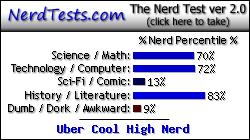
Now YOU do it!
Now YOU do it!
Thursday, September 06, 2007
Security testing book review on Dr. Dobbs site
I wrote a review for "The Art of Security Testing" a while ago for Dr. Dobbs. I found out only now that it's online at the Dr. Dobbs's Portal site. Read it here.
Wednesday, September 05, 2007
Weinberg on Agile
A short but sweet PM Boulevard interview with Jerry Weinberg on Agile management/methods. Of course, he says we need to drop the A and actually drop 'agile' altogether at some point, and just talk about "normal, sensible, professional methods of developing software." Count me in.
Tuesday, September 04, 2007
Jakob Nielsen on fancy formatting and fancy words
Just received the latest Alertbox newsletter from Jakob Nielsen. The topic is "Fancy Formatting, Fancy Words = Ignored". I'd have put 2 equal signs in there, but anyway....The 'ignored' in question is your web site, if you're trying to draw attention to important facts/figures by using red bold letters and pompous language. Nielsen's case study in the article is the U.S. Census Bureau's homepage, which displayed the current population of the US in big red bold letters, and called it "Population clock". As a result, users were confused as to the meaning of that number, and what's more, they didn't bother to even read the full number, because they thought it's an ad of some sort. Interesting stuff.
Friday, August 24, 2007
Put your Noonhat on
You may have seen this already, but here's another short blurb from me: Brian Dorsey, a familiar face to those of you who have been at the last 2 or 3 PyCon conferences, has launched a Django-based Web site he called Noonhat. The tagline says it all: "Have a great lunch conversation". It's a simple but original, fun and hopefully viral idea: you specify your location on a map, then you indicate your availability for lunch, and Noonhat puts you in touch with other users who have signed up and are up for lunch in your area at that time.
This has potential not only for single people trying to find a date, but also for anybody who's unafraid of stepping out of their comfort zone and strike interesting conversations over lunch. Brian and his site have already been featured on a variety of blogs and even in mainstream media around Seattle. Check out the Noonhat blog for more details.
Well done, Brian, and may your site prosper (of course, the ultimate in prosperity is being bought by Google :-)
This has potential not only for single people trying to find a date, but also for anybody who's unafraid of stepping out of their comfort zone and strike interesting conversations over lunch. Brian and his site have already been featured on a variety of blogs and even in mainstream media around Seattle. Check out the Noonhat blog for more details.
Well done, Brian, and may your site prosper (of course, the ultimate in prosperity is being bought by Google :-)
Tuesday, August 21, 2007
Fuzzing in Python
I just bought "Fuzzing: Brute Force Vulnerability Discovery" and skimmed it a bit. I was pleasantly surprised to see that Python is the language of choice for many fuzzing tools, and clearly the favorite language of the authors, since they implemented many of their tools in Python. See the fuzzing.org site/blog also, especially the Fuzzing software page. Sulley in particular seems a very powerful fuzzing framework. I need to look more into it (so much cool stuff, so little time.)
Update: got through the first 5-6 chapters of the book. Highly entertaining and educational so far.
Update: got through the first 5-6 chapters of the book. Highly entertaining and educational so far.
Wednesday, August 08, 2007
Werner Vogels talk at QCon
Werner Vogels is the CTO of Amazon. You can watch a talk he gave at the QCon conference on the topics of Availability and Consistency. The bottom line is that, as systems scale (and for amazon.com that means hundreds of thousands of systems), you have to pick 2 of the following 3: Consistency, Availability, Partitioning (actually the full name of the third one is "Tolerance to network partitioning.) This is called the CAP theorem, and Eric Brewer from Inktomi first came up with it.
Vogels pretty much equated partitioning with failure. Failure is inevitable, so you have to choose it out of those 3 properties. You're left with a choice between consistency and availability, or between ACID and BASE. According to Vogels, it turns out there's also a middle-of-the-road approach, where you choose a specific approach based on the needs of a particular service. He gave the example of the checkout process on amazon.com. When customers want to add items to their shopping cart, you ALWAYS want to honor that request (obviously because that's $$$ in the bank for you). So you choose high availability, and you hide errors from the customers in the hope that the system will sort out the errors at a later stage. When the customer hits the 'Submit order' button, you want high consistency for the next phase, because several sub-systems access that data at the same time (credit card processing, shipping and handling, reporting, etc.).
I also liked the approach Amazon takes when splitting people into teams. They have the 2-pizza rule: if it takes more than 2 pizzas to feed a team, it means the team is too large and needs to be split up. This equates to about 8 people per team. They actually make architectural decisions based on team size. If a feature is deemed to large to be comprehended by a team of 8 people, they split the feature into smaller pieces that can be digested more easily. Very agile approach :-)
Anyway, good presentation, highly recommended.
Vogels pretty much equated partitioning with failure. Failure is inevitable, so you have to choose it out of those 3 properties. You're left with a choice between consistency and availability, or between ACID and BASE. According to Vogels, it turns out there's also a middle-of-the-road approach, where you choose a specific approach based on the needs of a particular service. He gave the example of the checkout process on amazon.com. When customers want to add items to their shopping cart, you ALWAYS want to honor that request (obviously because that's $$$ in the bank for you). So you choose high availability, and you hide errors from the customers in the hope that the system will sort out the errors at a later stage. When the customer hits the 'Submit order' button, you want high consistency for the next phase, because several sub-systems access that data at the same time (credit card processing, shipping and handling, reporting, etc.).
I also liked the approach Amazon takes when splitting people into teams. They have the 2-pizza rule: if it takes more than 2 pizzas to feed a team, it means the team is too large and needs to be split up. This equates to about 8 people per team. They actually make architectural decisions based on team size. If a feature is deemed to large to be comprehended by a team of 8 people, they split the feature into smaller pieces that can be digested more easily. Very agile approach :-)
Anyway, good presentation, highly recommended.
Tuesday, August 07, 2007
Automating tasks with pexpect
I started to use pexpect for some of the automation needs I have, especially for tasks that involve logging into a remote device and running commands there. I found the module extremely easy to use, and the documentation on the module's home page is very good. Basically, if you follow the recipe shown there for logging into an FTP server, you're set.
A couple of caveats I discovered so far:
A couple of caveats I discovered so far:
- make sure you specify correctly the text you expect back; even an extra space can be costly, and make your script wait forever; you can add '.*' to the beginning or to the end of the text you're expecting to make sure you're catching unexpected characters
- if you want to print the output from the other side of the connection, use child.before (where child is the process spawned by pexpect)
#!/usr/bin/env python

import pexpect

def show_virtual(child, virtual):
    child.sendline ('show server virtual %s' % virtual)
    child.expect('SSH@MyLoadBalancer>')
    print child.before

def show_real(child, real):
    child.sendline ('show server real %s' % real)
    child.expect('SSH@MyLoadBalancer>')
    print child.before

virtuals = ['www.mysite.com']
reals = ['web01', 'web02']

child = pexpect.spawn ('ssh myadmin@myloadbalancer')
child.expect ('.* password:')
child.sendline ('mypassword')
child.expect ('SSH@MyLoadBalancer>')

for virtual in virtuals:
    show_virtual(child, virtual)

for real in reals:
    show_real(child, real)

child.sendline ('exit')
Think twice before working from a Starbucks
Here's an eye-opening article talking about a tool called Hamster that sniffs wireless traffic and reveals plain-text cookies which can then be used to impersonate users. The guy running the tool was able to log in into some poor soul's Gmail account during a BlackHat presentation.
Pretty scary, and it makes me think twice before firing up my laptop in a public wireless hotspot. The people who wrote Hamster, from Errata Security, already released another tool called Ferret, which intercepts juicy bits of information -- they call it 'information seepage'. You can see a presentation on Ferret here. They're supposed to release Hamster into the wild any day now.
Update: If the above wasn't enough to scare you, here's another set of wireless hacking tools called Karma (see the presentation appropriately called "All your layers are belong to us".)
Pretty scary, and it makes me think twice before firing up my laptop in a public wireless hotspot. The people who wrote Hamster, from Errata Security, already released another tool called Ferret, which intercepts juicy bits of information -- they call it 'information seepage'. You can see a presentation on Ferret here. They're supposed to release Hamster into the wild any day now.
Update: If the above wasn't enough to scare you, here's another set of wireless hacking tools called Karma (see the presentation appropriately called "All your layers are belong to us".)
Thursday, August 02, 2007
That's what I call system testing
According to news.com, the IT systems for the 2008 Olympics in Beijing will be put through rigorous testing which will take more than 1 year! The people at Atos Origin, the company in charge of setting up the IT for the 2008 Olympics, clearly know what they are doing.
It's also interesting that the article mentions insiders as a security threat -- namely, that insiders will try to print their own accreditation badges, or do it for their friends, etc. As always, the human factor is the hardest to deal with. They say they resort to extensive background checks for the 2,500 or so IT volunteers, but I somehow doubt that will be enough.
It's also interesting that the article mentions insiders as a security threat -- namely, that insiders will try to print their own accreditation badges, or do it for their friends, etc. As always, the human factor is the hardest to deal with. They say they resort to extensive background checks for the 2,500 or so IT volunteers, but I somehow doubt that will be enough.
Tuesday, July 31, 2007
For your summer reading list: book on Continuous Integration
I found out about this book from the InfoQ blog -- the book is called Continuous Integration: Improving Software Quality and Reducing Risk and it is written by 3 guys from Stelligent, who also blog regularly on testearly.com. Seems like a very interesting and timely read for people interested in automated testing and obviously in continuous integration (which to me are the 2 first stepping stones on the path to 'agile testing'). You can also read a chapter from the book in PDF format: "Continuous testing".
Monday, July 30, 2007
Notes from the SoCal Piggies meeting
Saturday, July 28, 2007
Dilbert, the PHB, and automated tests
Today's Dilbert cartoon shows that even the PHB can think "agile". He tells Dilbert to go write his own automated test software, instead of buying off-the-shelf. That's got to be agile, with small "a" :-) Of course, it's not recommended to call your team members "big babies" during the stand-up meeting.
Friday, July 27, 2007
Your purpose is the Python group
At our last SoCal Piggies meeting 2 days ago, Diane Trout showed us some Jabber bots, one of them based on PyAIML, an Eliza/AI kind of bot. When Diane asked this awfully intelligent little bot to smile for the Python group, this is what it replied:

How did it guess??? I used to not be a big believer in AI, but now I'm sold.

How did it guess??? I used to not be a big believer in AI, but now I'm sold.
Pybots updates
After a long hibernation period, the Pybots project shows some signs of life -- I should probably say mixed with signs of death. Elliot Murphy from Canonical added the Storm ORM project to his AMD64 Ubuntu Gutsy buildslave, while Manuzhai and Jeff McNeil had to drop their buildslaves out of the mix, hopefully only temporarily. In Manuzhai's case though, the project he was testing -- Trac -- proved to have maintainers that were not interested in fixing their failing tests. In this case, there is no point in testing that project in Pybots. Hopefully Manuzhai will find a different, more test-infected project to run in Pybots.
Speaking of test-infected projects, it was nice to see unit testing topping the list of topics in the Django tutorial given at OSCON by Jeremy Dunck, Jacob Kaplan-Moss and Simon Willison. In fact, Titus is quoted too on this slide, which seems to be destined to be a classic (and I'm proud he uttered those words during the Testing Tools Panel that I moderated at PyCon07). Way to go, Titus, but I'd really like to see some T-shirts sporting that quote :-)
Speaking of test-infected projects, it was nice to see unit testing topping the list of topics in the Django tutorial given at OSCON by Jeremy Dunck, Jacob Kaplan-Moss and Simon Willison. In fact, Titus is quoted too on this slide, which seems to be destined to be a classic (and I'm proud he uttered those words during the Testing Tools Panel that I moderated at PyCon07). Way to go, Titus, but I'd really like to see some T-shirts sporting that quote :-)

Saturday, July 07, 2007
Another Django success story
Thursday, June 21, 2007
Interested in a book on automated Web app testing?
Want to know more about twill and Selenium? In this case, I happen to know a very good book just published in the O'Reilly Short Cuts series :-) It's cheap too, $9.99, so please go buy it!
Wednesday, June 06, 2007
Brian Marick on "Four implementation styles for workflow tests"
Brian Marick just posted a very insightful article on various types of Web application tests that he calls 'workflow tests'. If you're in the Web application testing business, this should help you decide which type -- or better which TYPES (plural) -- of tests to use in your specific application scenario.
Subscribe to:
Posts (Atom)